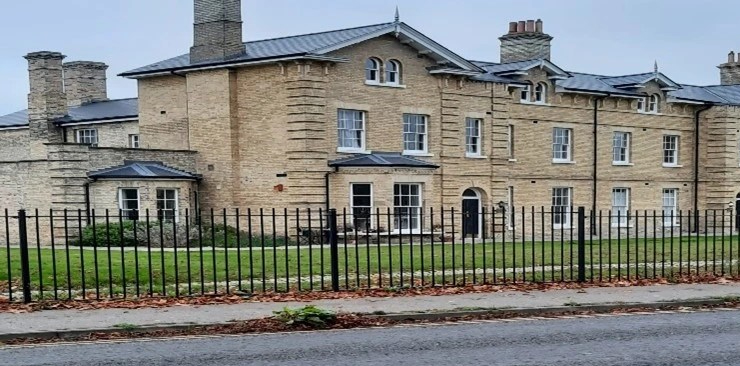
Flagstaff House in Colchester*. The end of one career and the start of a new one.
Walking across the grounds of the military headquarters at Flagstaff House in Colchester for the last time, I was about to embark on my second career with just a weekend in between as a break. It had been my workplace for the last seven years and was the last posting of my 24-year career with the Army. It was a career that had surpassed all my expectations.
In the year leading up to my military retirement, I needed to decide whether I would be looking for a second career or a job. I decided on a career and one I was going to be equally enthusiastic about. It was going to be personal. Being the father of a young person with a learning disability and autism, I wanted (and was going to) make a difference for people with a learning disability.
I recently received an invitation from another department of our organisation to give an inspirational talk during their ‘away-day’. They chose ‘Career Development’ from a list of topics on offer.
As I prepared my presentation it gave me the opportunity to reflect on the things I have learned and which I could share with my audience. I have ten areas of learning – which I believe have helped me – and I hope you also find them helpful.
10 Things I have learned:
1. Networking – It really is about who you know.
My life has been enriched by the people I know, and I have concluded that the success I have achieved (in both careers) has often been down to knowing the right people. My definition of a network: ‘people sharing an aim, interest etc. and frequently communicating with or helping each other.’ Done correctly, networking promotes your career; helps you learn from the people you network with; provides a sounding board for your ideas and, if you get stuck with a problem or situation, a good network will always know someone who can help you.
Related: Networking: it really is all about who you know – Leadership in the Raw
Tip: When you walk in the room adopt the mindset “what can I do for you?” rather than “what you can do for me?”.
2. Who is your Mentor? Who is your Coach?
Both mentoring and coaching are processes that enable you to achieve your full potential. Mentors are someone who will give you the answers based on their experience and knowledge. Coaches are those who support you to formulate your own solutions. A mixture of both mentoring and coaching has helped accelerate my career and I have always actively sought Mentors and Coaches.
Tip: Look for a Mentor and/or Coach in specific areas where you think you may have gaps you want to develop/progress.
| “I’ve got the attitude which I still have today that if I find someone that I really admire, someone that I think, I want to be you. I want to do the things the way you do them. I’ve always sort of been stupid enough or brave enough to go up to them and say, will you mentor me?” Rene Carayol – Businessman, Speaker, Author, and Broadcaster |
3. Qualifications and Continued Professional Development (CPD) –
Starting out on my second career I felt I was starting from scratch. Most of my military qualifications were not transferrable at the time and it was one of Joyce’s (my wife) pearls of wisdom: “A qualification a year, get back into the learning habit and invest in yourself”. From experience qualifications are the only investment you can guarantee a return on. Your CV gets you a seat at the interview table.
Tip: Do not put all your eggs in one basket. Have a spread of qualifications. Mine include Leadership, Coach & Mentoring, Project Management, Training, Management and Social Care.
4. Voluntary Work.
Broadens your outlook and enhances your skill set. It was voluntary work during my army career supporting a residential home for people with a learning disability in Berlin and organising social events for them that attracted me to my current career. Subsequently I have been a citizens advocate for a person with a learning disability; a school governor at a special needs school; a Trustee for a Carers Centre and several projects for a military charity which included being a mentor for wounded, injured and sick (WIS) armed forces personnel.
Tip: Look for something you are passionate about where you can make a difference
5. Add Value – what is it you bring to the table?
Doing a good job is a given, so what makes you different? Adding value means going beyond your job description. Investing more time and effort than is required of doing a job well. Linking your work to specific organisational objectives enables you to focus on the tasks that will have the biggest impact on your team and company’s success. What is your added value?
Related: The 8th Leadership Lesson I learned – Add Value – Leadership in the Raw
Tip: A question to repeatedly ask yourself. What is my unique selling point (USP)?
6. ‘Snakes and Ladders’ Prepare for the Ups and Downs
Not everything will go according to plan. There will be appointments and roles where you feel you are a square peg in a round hole. This happened to me in the late 1980s. I had just spent three years in a Commando Squadron and then proceeded to a completely different unit. Despite my best efforts I found it difficult to fit in with an entirely different work culture. While I saw this as a setback in career terms, I was determined to learn as much as possible from this experience and consider what I would do better and different in my next posting.
Tip: Accepting this will can happen, and not only once, enables you to be more resilient, enabling you to bounce back better. Think of it as a learning experience.
7. The Art of Reinvention.
I love life. I want to be the best I can be, therefore, why do I feel the need to reinvent myself and how will it help me progress in my career(s)? Reinvention has worked for me:
- By stretching myself – early on I came to the realisation that only when I am really challenged am I at my best.
- It keeps me fresh and motivated.
- It gives you a competitive edge.
- It helps me recover from setbacks, obstacles, and events outside of my control.
Re-inventing myself has often happened when I have changed a job role and or moved between organisations.
Tip: It is an opportunity to do things differently, be known for something new and test out new theories.
Related: The Art of Reinvention – Leadership in the Raw
8. Surround yourself with talent
If you want to be the best person you could possibly be, then surrounding yourself with talent will fill gaps in both your own knowledge/expertise. You cannot know it all.
| “If you have the ability to work with people smarter than you, always try to be the least smart person in the room and surround yourself with talent, because iron sharpens iron.” Jake M Johnson |
Related: The 3rd Leadership Lesson I learned – Surround yourself with Talent – Leadership in the Raw
Tip: Actively seek out great people to work with. People who will inspire you and from whom you will learn.
9. Be Lucky.
My younger brother (who was also in the Army) once told me he thought I had joined a travel company rather than the Army due to the number of places I was sent to. I must admit I got to visit and work in some amazing places and do some exciting things. For me being lucky in life/work is all about ‘when preparation meets opportunity’ I have always put time aside for preparation and research whilst maintaining an awareness of opportunities that may present themselves (often when least expected).
Related: The 6th Leadership Lesson I learned – Creating Opportunities – Leadership in the Raw
Tip: When someone asks if you are ready to take on an exciting new role or responsibility. Say “yes” then get busy finding out how to do it.
10. Do the work you were always meant to do.
Life is short and as my wife, Joyce, often reminds me, you are in work a long time, so it is important that you are happy doing what you do. Here are some questions you should ask yourself if you are going to do the work you were always meant to do:
- What is it that you are enthusiastic about?
- Do you want your work to have influence?
- What will it take to make you feel fulfilled?
- What skills, experiences, knowledge, gifts, and capabilities do you have?
Related: https://leadershipintheraw.org/2016/07/27/do-the-work-you-were-always-meant-to-do/
Tip: Do you want a job or a career? Both are good but it is important for your expectations that you know so that you decide what it is you really want to do.
In the football game of life, my career development has been played out in two halves with no half time and I am now going into ‘extra time’, Hopefully it will not go to penalties.
| “I would like to be remembered as someone who did the best, she could with the talent she had.” J.K. Rowling |
Steve Raw
* Flagstaff House is no longer a Ministry of Defence property and has been converted into residences.
 Leadership in the Raw