
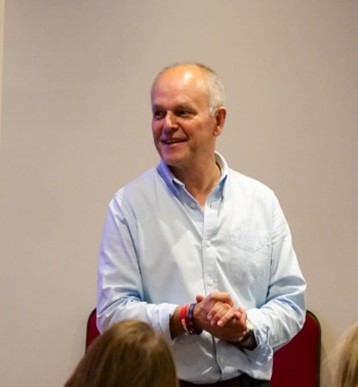
Taking the time to deliver a presentation on Time Management to Team managers.
Unlike talent, or money, or luck, there is one resource that is distributed to every one of us equally. We each get 24 hours a day and it is how we use those 24 hours that sets people apart. Change the way you use your time, and you change your life.
I love life and even though I am about to retire (and perhaps when you read this post, I will have already retired) there is so much I want to do and achieve in the time I have.
“All we have to decide is what to do with the time that is given to us”.
J.R.R. Tolkien
My 20 top tips from 50+ years work experience in two careers (Army & Social Care) and from 40+ years of marriage to Joyce Raw. (Joyce is my coach and mentor especially when it comes to time management).
1. Eat the Frog! What is the most challenging, but potentially rewarding task that you can do today? Don’t put it off doing it until the end of the day – you’ll waste time doing less important things and worrying about how you still must “eat the frog”. Write it down. Make it your first task of the day and then relax!
“If it is your job to eat a frog, it’s best to do it first thing in the morning.
And if it’s your job to eat two frogs, it’s best to eat the biggest one first”.
Mark Twain
2. Appointments: Call ahead to make sure people are on schedule if you have an appointment with them and if they cancel appointments with you, have alternative plans for that time slot. Cancelled Appointments? Leave them in your calendar and use it for some creative work if you don’t someone with access to your online calendar will fill it for you.
3. Commuting: Check the weather forecast at least the day before your commute so you can prepare your mode of travel and what you need to wear rather than leave it to the last minute. Organise commuting time; share rides or rehearse speeches and presentations. On my long journeys I would listen to management & leadership podcasts.
4. Turn up early: It is much better to turn up 30 minutes early for a meeting than try to get there just in time. You can always check your emails while you are waiting to go into your meeting.
5. Interruptions: Stand up when interrupted. My wife Joyce puts her finger on the word she was reading if I interrupt her. Telephone Interruptions: Do not ask open-ended questions. Unless someone leaves a voice mail, I do not get back to them. Telephone Interruptions: I have a routine that I only check my phone four times a day. People who regularly phone you will soon recognise this routine. Think before you interrupt anyone: Their time is as valuable as yours
6. Write a to-do list every day: Always write your plans in pencil. I put an exclamation mark against the jobs I must do today. I then codify them with a ‘Significance Factor’ how important & urgent will this task be for my organisation and our stakeholders? Score each ‘to do task’ out of five with five being the most significant.
7. “Take something with you!” In the ‘Raw’ family, if you are going upstairs, there is an expectation that you will take something with you e.g. after weekly shop, Joyce may have put some toiletries on the stairs for our bathroom. Woe betides you, if you ignore them when you are going upstairs for another reason.
8. Planning: Spend ten minutes at the beginning of each day, planning. At the end of the day review your success by asking: ‘What have I done today to move towards my goals?’
9. Clock watching: If you work in an office, position a clock in your office so it is visible to you and to visitors.
10. Tactics: Do not sit down if you are followed into your office. Keep all chance meetings short by standing as it will then be easier to get away.
11. Pressing: I have two weeks’ worth of kit pressed so I am never caught out. It means I can crack on with urgent work early in the morning or if I am back late because of a long journey.
12. Recognising when you are at your most productive: We all have our peak times. Do you know yours? My peak is early in the morning, so that is when I complete my most important, urgent, and complex tasks.
13. Have a purpose: If it is not going to make a difference to your job, the people you support, or your organisation then don’t do it! Time management is often about eliminating waste in your day.
14. Sweat the small stuff: Identify a potential problem, issue, or concern when it is small and deal with it. If you think you haven’t got the time to deal with it now, you will have to find the time when it has become big and awry.
Related: The 9th Leadership Lesson I learned – Sweat the Small Stuff – Leadership in the Raw
15. Go for a walk: Go for a walk when you have a difficult problem to resolve. This gives the time to reflect you will not get sitting at your desk. It will get things into perspective, I promise.
16 Starting your day Do everything with intent. If you endeavour to do something, this indicates intent. First 30 minutes of the day, do stuff for you, not others so you are working to your agenda not someone else’s. 5 before 11: I write down five jobs to do before 11am. The compound effect! See how many jobs you will have accumulated over a week, a month!
17. The way you begin a call affects the way you end it: You can start a phone call by saying “Hi Susan, I only have 5 minutes to talk, but I wanted to let you know that……”
18. For each work task, set deadline for completion. So, you don’t drift or allow yourself to be distracted. I find setting a time to complete a task helps keep me focused, my competitive bent makes me try and beat the deadline. I set one hour to prepare this Time Management Presentation.
19. Do what you can today, that will save you time tomorrow. I picked this one up as a young soldier from an officer I worked for. When I said I would do the task the next day, he said you don’t not know what you may face in the morning, if you do it now, it will save you time tomorrow.
20. Work out your Boss timetable. Knowing when your boss is at their most receptive to giving you the response you need, I found it helpful, knowing what her timetable was. I had worked for her, over 20 years and had worked out she checked her emails at 0830hrs, so that was the time I would send my message so it would come in at the top of her inbox.
And a bonus. My favourite Time Management presentation:
How to gain control of your free time? Laura Vanderkam
Source: Steve Raw www.leadershipintheraw.org
 Leadership in the Raw