
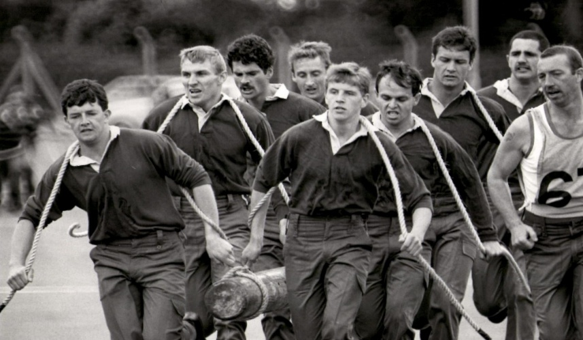
Commando (Royal Marine) Log Race. ‘Engine stokers’ who drove this winning team forward.
Joyce (my wife) and I were watching ‘Manhunt’ on tv last night, a limited series based on DCI Chris Sutton’s memoirs. There was something we noticed within the dynamics of his leadership and team. We picked up that he seemed to focus on one police officer (who was junior in rank) for advice, a sounding board for his thinking and then asked him to draft an important email that would secure investigative funding. This prompted a conversation between us and a sharing of leadership experiences where we had recognised a key player within the team. Joyce used the term an ‘engine stoker.’
(Engine stoker: a person who tends the fire for the running of a boiler or powering a steam engine.)
During my careers in the Army and Social Care, I identified a key player/engine stoker within all my teams, and I was to benefit as a leader and manager from their support, competency, and skills.
I have based this article on several former colleagues I had the privilege to work with in both my careers:
Who is the ‘engine stoker’ and how do you identify them?
- They are quite happy to stoke the boiler – the position they are employed in is not necessarily senior in ‘rank’ but is significant in ‘role’ for the functioning and movement of the company.
- They are respected for their integrity by their colleagues. They provide continuity within the organisation.
- They have often worked in other fields and may have held down senior positions and therefore possess a wide range of experience(s). They may have a particular specialism and or skill that is invaluable to the organisation.
- Often not seeking seniority or overly ambitious in their current employment. Doing an excellent job to their best capabilities is more important to them.
- They do not have hidden agendas; they are transparent in their dealings. You know when you seek their advice or opinion, what they tell you is in the best interests of the operation, not their best interests,
- They may have been with the company a long time and they are committed to the values and ethos of the organisation.
What do they bring to your team:
- They act for the greater good. They care passionately about what your team are trying to achieve for their customers.
- They identify potential issues before you do – they often have ready-made solutions to those problems.
- They are happy to share their knowledge and experience to progress your team’s vision and mission.
- They have a unique perspective on the situation, through having a freedom of thought which is not burdened by the weight of leadership and management responsibilities.
- They retain the trust and respect of their colleagues.
- I found having their support with a proposal and or project adds credibility to your initiative.
How to encourage a culture that recognises and celebrates their contribution.
- Involvement ‘they have a seat at the table.’ Make sure you invite them to all your project and management meetings.
- Delegate responsibility for tasks that match their talents and experience.
- Feedback – regularly ‘check-in’ with them for their feedback. Be prepared that it might not be what you want to hear! But do know their feedback is coming from a good place.
- Recognition – Highlight their contributions both in meetings and reports.
- Reward. Find ways that are meaningful to the individual to reward their contribution, a small token can make a big difference.
During my army career I had the opportunity of serving within a Royal Marine Commando Regiment for 30 months. One of the differences I noted was the way ‘Royal’ senior ranks and officers highly respected and valued the long serving and experienced ‘Marine’ who was not going to progress within the ranks during their career. They were sought out for their advice, experience, and knowledge. They were highly valued!
This was leadership lesson which stayed with me and something I benefited from during my second career in Social Care.
Source: Steve Raw
The ‘Leadership Lessons I learned’ series (1 – 12) can be found on www.leadershipintheraw.org ‘Home Page’.

