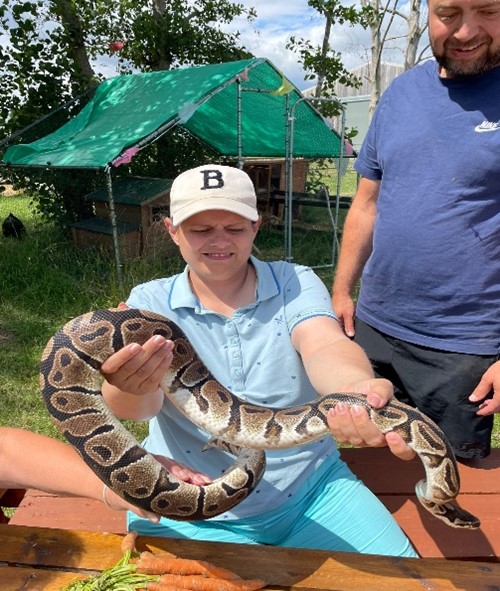
Bettina getting comfortable with a snake!
On the way to our new holiday destination in Cornwall, driving down what is laughingly called a ‘B’ road – thanks to the satnav – the road is barely the width of our car, and we are constantly hoping there is not going to be a tractor coming the other way. You could say I am feeling uncomfortable.
I can feel Bettina’s tension and anxiety coming from the back seat and not just because of the narrow road I am taking her down, but because this is also a new destination for her – which Bettina refers to as “New Devon Holiday.” For the last 15 years our annual holiday has been in part of the Southwest of England and always at the same holiday park, but this year is different. Unfortunately, the usual site had changed ownership several weeks before we were due to arrive and once again we were going to have to find a way of supporting Bettina to be comfortable with being uncomfortable.
If you are new to Bettina’s story, she is a woman who copes with autism, a learning disability and epilepsy. People with autism can find any kind of change difficult. Reality to an autistic person is a confusing, interacting mass of events, people, places, sounds and sights, but there are many things you can do to support them.
For some time, I have wanted to write a piece about getting comfortable with being uncomfortable. Originally, it was going to be part of the ‘Leadership Lessons I have learned’ series I include, however, my experiences pale into insignificance when I compare myself to what Bettina has to contend with, often on a daily basis.
I took the opportunity to make some notes during our two-week holiday about how Bettina deals with situations and how her family supports her. I hope these tips help you too.

Bettina’s coping mechanisms – getting comfortable with being uncomfortable:
- Finding rituals that work for Bettina. They help her to cope and calm her. This may include mantras she will say and repeat to herself, often in a faint voice so they do not attract attention.
- Bettina knows from experience she is not alone and that those around her will help to keep her safe and secure.
- Bettina keeps strong as even though this period is going to be uncomfortable for her, she knows she will get through it.
- Bettina looks for things that have similarities that provide an anchor for her. During our holiday (and often at home and work) she looks for familiar activities and routines and which help cope with the change.
- Bettina holds items close to her that are precious and loved so she can reach out to them when she is feeling anxious and uncomfortable.
What her family do to support Bettina:
- We walk with purpose; we give the appearance that we are confident in what we are doing (even though we might not feel that way at the time) and retain a positive mindset. This reassures Bettina and helps her feel secure.
- Prior – Planning and Preparation. Prior to our holiday Joyce (her mum) prepared the ground by sharing pictures and short videos of the holiday park and the surrounding area with Bettina. We did as much background planning, e.g., routes etc, so that Bettina would notice our confidence and knowledge.
- Words matter. We called the change in our holiday destination “New Devon Holiday”, so Bettina knew things were going to be different. Both before and during the holiday she regularly referred to it as “New Devon Holiday”.
- Balance change with familiarity. This holiday was new but our next holiday in several weeks is to a place we have been going to for the last 20 years and therefore ultimately familiar and reassuring.
Five lessons I have learned from supporting Bettina with being comfortable with being uncomfortable, that will help me:
- Acceptance. Accepting that there will be obstacles in my life so that I am not surprised when I come up against them. When I set out on my travels to my head office in Grantham, I expect that at some point on my journey there will be a road closure and I am pleasantly surprised if there isn’t one (or two). This lesson helps me feel comfortable with being uncomfortable with a diversion through unfamiliar country lanes.
- Self-affirmation that we are motivated to maintain our self-worth in the face of threats (Sherman & Cohen, 2006). When our self-esteem is threatened, we sometimes affirm other parts of ourselves unrelated to the threat.
- The need to adapt and overcome. It is only after have stepping outside your comfort zone that you begin to change, grow, and transform. Roy T. Bennett
Related: Being Bettina’s Dad – Adapt and Overcome – Leadership in the Raw
- Introducing minor changes over a period and looking for quick successes.
- “Success is not final; failure is not fatal. It is the courage to continue that counts” Winston Churchill. This something we have learned throughout Bettina’s life during times of unplanned change or adversity.
I recently ran into some turbulence at work – which is likely to last for some months. I know I will have to get comfortable with being uncomfortable. A wise colleague said to me “think about all the times when you have had to do this.” I have lots of examples, but one I think we can call on is Covid 19. This was a supreme test for Bettina and her family’s resilience. Here some more lessons of how we got through this together: https://leadershipintheraw.org/2020/04/08/being-bettinas-dad-this-too-shall-pass-the-lockdown/ You can do more than you think you can.
Steve Raw www.leadershipintheraw.org
 Leadership in the Raw